

Hey there! As a supplier of submersible agitators, I often get asked about the power range of these nifty devices. So, I thought I'd write this blog to shed some light on the topic.
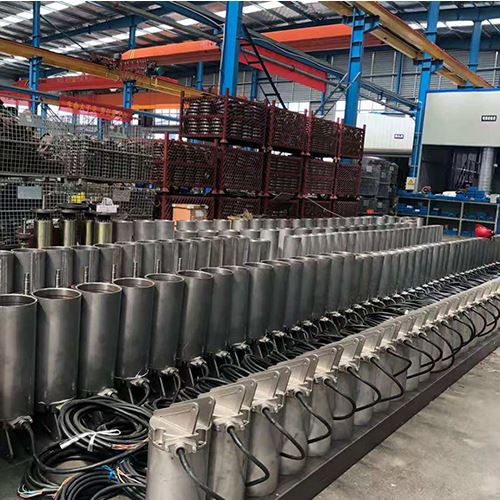
First off, let's understand what submersible agitators are. They're basically machines designed to stir, mix, or circulate liquids in various applications, like wastewater treatment plants, industrial processes, and even in some large aquariums. They're submerged directly into the liquid, which allows for efficient mixing right at the source.
Now, onto the power range. The power of submersible agitators can vary quite a bit depending on the specific model and its intended use. Generally, the power range can start from as low as 0.37 kilowatts (kW) and go all the way up to 22 kW or even higher in some industrial - grade models.
For smaller applications, like small - scale wastewater treatment ponds or home aquariums, a lower - power submersible agitator might be sufficient. A 0.37 - 1.5 kW agitator can do a great job in these cases. These low - power models are usually more energy - efficient and are easier to handle. They're also less expensive, which makes them a great choice for budget - conscious users.
On the other hand, in large industrial settings such as big chemical plants or large - scale wastewater treatment facilities, higher - power agitators are required. Agitators with a power rating of 5.5 - 22 kW or more are commonly used here. These high - power models can generate a strong flow and mixing force, which is necessary to handle large volumes of liquid and to ensure thorough mixing of different substances.
Let's take a closer look at some of the factors that influence the power requirement of a submersible agitator.
Liquid Viscosity
The viscosity of the liquid being mixed is a major factor. If you're dealing with a thin, watery liquid, a lower - power agitator can usually get the job done. But if the liquid is thick, like a sludge or a highly concentrated chemical solution, you'll need a more powerful agitator. The thicker the liquid, the more force is required to move it around and achieve proper mixing.

Tank Size and Shape
The size and shape of the tank also play a crucial role. In a small, compact tank, a lower - power agitator might be enough to create a good mixing pattern. However, in a large, irregularly - shaped tank, a higher - power agitator may be necessary to ensure that all parts of the tank are effectively mixed. A large tank requires more energy to circulate the liquid throughout the entire volume.
Mixing Intensity
The level of mixing intensity you need is another consideration. If you just need a gentle stirring to keep the liquid homogeneous, a lower - power agitator will work. But if you need a high - intensity mixing, for example, to dissolve solids quickly or to emulsify two immiscible liquids, a more powerful agitator is essential.
Now, let me introduce you to some of the submersible agitator products we offer. We have the QJB Submersible Mixer. This mixer is known for its reliability and efficiency. It comes in a variety of power ratings, so you can choose the one that best suits your needs. Whether you have a small - scale or a large - scale application, the QJB Submersible Mixer can be a great solution.
Another product we offer is the Submersible Mixer With Drift Barrel. This unique design helps to direct the flow of the liquid more effectively, which can enhance the mixing performance. It's available in different power options, allowing you to select the appropriate power based on your specific requirements.
We also have the Submersible Flow Thruster. This product is ideal for creating a strong flow in large tanks or basins. It can be used in applications where a high - velocity flow is needed to prevent sedimentation or to promote better circulation. And like our other products, it comes with a range of power choices.
When choosing a submersible agitator, it's important to carefully assess your specific needs. Consider the factors I mentioned earlier, such as liquid viscosity, tank size, and mixing intensity. This will help you select the right power rating for your application.
If you're in the market for a submersible agitator, don't hesitate to reach out to us. We have a team of experts who can provide you with detailed information and help you make the best choice for your project. Whether you're a small business owner or part of a large industrial operation, we're here to assist you. Contact us to start the procurement process and let's find the perfect submersible agitator for you.
References
- "Handbook of Industrial Mixing: Science and Practice" by Edward L. Paul, Victor A. Atiemo - Obeng, and Suzanne M. Kresta
- "Mixing: Principles and Applications" by J. Y. Oldshue


