

How does a Hyperboloid Mixer work?
As a supplier of hyperboloid mixers, I'm often asked about how these innovative pieces of equipment function. Hyperboloid mixers are an essential part of many industrial and wastewater treatment processes, offering efficient and effective mixing solutions. In this blog post, I'll delve into the working principles of hyperboloid mixers, their advantages, and applications, and also introduce some related products we offer.
The Working Principle of a Hyperboloid Mixer
At the heart of a hyperboloid mixer is its unique hyperboloid-shaped impeller. This shape is not just for show; it plays a crucial role in the mixing process. When the impeller rotates, it creates a complex flow pattern that is different from traditional mixers.

The rotation of the hyperboloid impeller generates a three - dimensional flow field. First, the impeller draws the liquid from the top and the bottom towards the center of the impeller. As the liquid approaches the impeller, it is accelerated by the high - speed rotation of the blades. The hyperboloid shape of the impeller causes the liquid to spread out in a radial direction as it moves away from the center of the impeller. This creates a large - scale circular flow in the tank, which helps to distribute the substances evenly throughout the liquid.
The hyperboloid shape also allows for a more efficient transfer of energy from the impeller to the liquid. Compared to flat - blade or other simple - shaped impellers, the hyperboloid impeller can generate a stronger and more stable flow with less power consumption. This is because the shape of the impeller reduces the formation of eddies and turbulence in areas where they are not needed, and instead focuses the energy on creating a useful flow pattern for mixing.
Another important aspect of the hyperboloid mixer's operation is the adjustable speed. Most hyperboloid mixers are equipped with a variable - speed drive, which allows operators to control the mixing intensity according to the specific requirements of the process. For example, in a wastewater treatment plant, different stages of the treatment process may require different mixing speeds. During the initial stages of sedimentation, a lower speed may be sufficient to prevent the settling of solids. In the later stages of biological treatment, a higher speed may be needed to ensure good contact between the microorganisms and the pollutants in the water.
Advantages of Hyperboloid Mixers
One of the main advantages of hyperboloid mixers is their high efficiency. As mentioned earlier, the unique shape of the impeller allows for a more effective transfer of energy to the liquid, resulting in a more thorough mixing with less power consumption. This not only saves energy costs but also reduces the wear and tear on the equipment, leading to lower maintenance costs over the long term.
Hyperboloid mixers also have a wide range of applications. They can be used in various industries, including wastewater treatment, chemical processing, food and beverage production, and pharmaceutical manufacturing. In wastewater treatment, they are used to mix chemicals, prevent sedimentation, and promote the growth of beneficial microorganisms. In the chemical industry, they can be used to blend different chemicals or to maintain a homogeneous suspension of solids in a liquid.
The design of hyperboloid mixers also makes them suitable for use in large - scale tanks. The large - scale circular flow created by the impeller can cover a large volume of liquid, ensuring uniform mixing throughout the tank. This is particularly important in industrial processes where large quantities of liquids need to be mixed.
In addition, hyperboloid mixers are relatively easy to install and maintain. They can be mounted either vertically or horizontally in the tank, depending on the specific requirements of the application. The simple design of the mixer also means that there are fewer parts that can break down, making maintenance and repair work straightforward.

Applications of Hyperboloid Mixers
As a supplier, I've seen hyperboloid mixers being used in a variety of applications. In wastewater treatment plants, they are a key component in the primary and secondary treatment processes. In the primary treatment stage, hyperboloid mixers are used to mix the incoming wastewater with chemicals such as coagulants and flocculants. This helps to agglomerate the suspended solids in the water, making them easier to remove through sedimentation or filtration.

In the secondary treatment stage, which involves biological processes, hyperboloid mixers are used to maintain a uniform distribution of microorganisms in the wastewater. The microorganisms break down the organic pollutants in the water, and the mixer ensures that they have sufficient contact with the pollutants to carry out this process effectively.
In the chemical industry, hyperboloid mixers are used in the production of various chemical products. For example, in the production of paints and coatings, they are used to mix different pigments, solvents, and additives to ensure a consistent quality of the final product. In the production of polymers, they can be used to mix the monomers and catalysts evenly, which is crucial for the polymerization process.
In the food and beverage industry, hyperboloid mixers are used to mix ingredients in the production of products such as dairy products, juices, and sauces. They help to ensure a uniform texture and flavor of the final products.
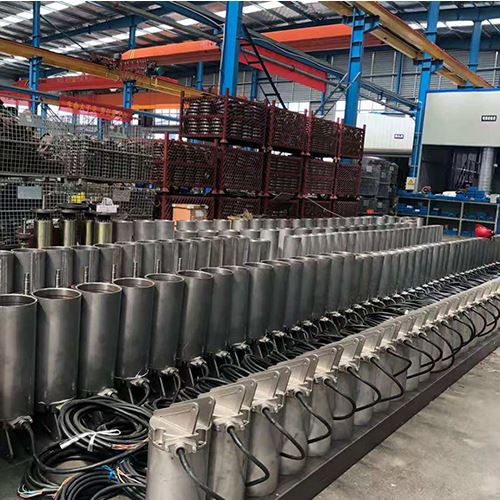
Related Products
In addition to hyperboloid mixers, we also offer a range of other mixing equipment. For example, our QJB Submersible Mixer is a popular choice for wastewater treatment applications. It is designed to be submerged in the liquid, and it can provide efficient mixing in small to medium - sized tanks.
Our Submersible Flow Thruster is another useful product. It is mainly used to create a directional flow in the tank, which can be beneficial in some applications such as preventing the formation of dead zones in the tank or promoting the circulation of the liquid.
We also have Frame Mixer, which is suitable for mixing in open - top tanks or large - scale industrial processes. The frame - mounted design provides stability and allows for easy installation and adjustment.
Conclusion
In conclusion, hyperboloid mixers are a highly efficient and versatile piece of equipment that can play a crucial role in many industrial and wastewater treatment processes. Their unique working principle, high efficiency, wide range of applications, and ease of installation and maintenance make them a popular choice among our customers.
If you are interested in learning more about our hyperboloid mixers or any of our other products, or if you have specific mixing requirements for your project, please feel free to contact us for a detailed consultation. We are committed to providing you with the best - suited mixing solutions and excellent customer service.
References
- "Mixing in the Process Industries" by Paul, E. L., Atiemo - Obeng, V. A., & Kresta, S. M.
- "Wastewater Treatment: An Overview" by Metcalf & Eddy.
- "Chemical Engineering Unit Operations" by McCabe, W. L., Smith, J. C., & Harriott, P.


